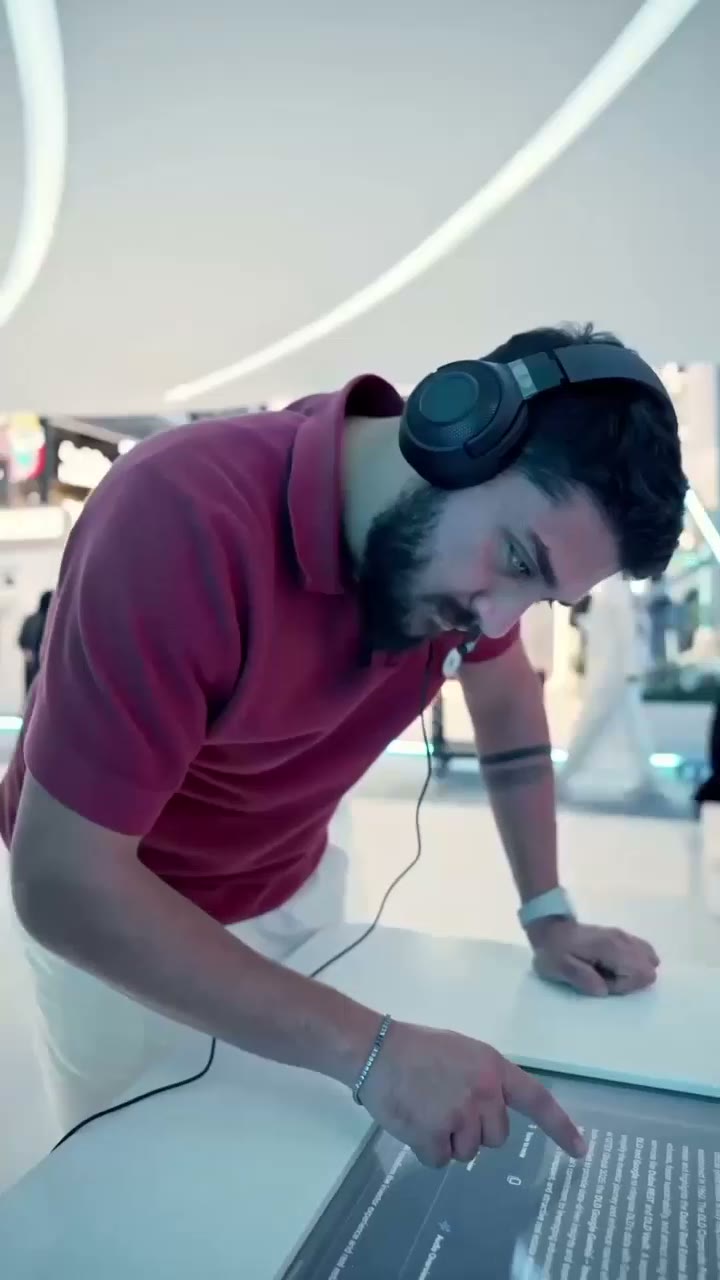
GITEX Global fills the Dubai World Trade Centre with thousands of exhibitors, and a large share of them have a screen running. Walk any hall and you are looking at a wall of simultaneous motion.
That environment punishes certain content choices and rewards others.
The four-second test
A visitor walking the aisle gives your stand a glance measured in seconds. In that window they should be able to answer one question: what does this company do?
Not your tagline. Not your funding round. What you actually do.
Content that opens with a slow logo animation spends its entire window of attention on something the visitor cannot use. Put the proposition first and the brand second - the brand is on the stand behind it anyway.
Motion everywhere means stillness stands out
When every screen in the hall is animating constantly, more motion does not win. It blends in.
Some of the most effective hall content uses deliberate stillness - a held frame, a slow reveal, a single moving element against a static field. It reads as confident rather than desperate, and in a room of constant movement it is genuinely disruptive.
Tech propositions need visual explanation
GITEX exhibitors frequently sell something with no physical form: a platform, a protocol, an infrastructure layer, a model. There is nothing to point a camera at.
This is where motion graphics and 3D earn their place - not as decoration, but as the only practical way to show how an abstract system works. A well-built diagram in motion communicates in fifteen seconds what a stand conversation takes five minutes to cover, and it works while your team is busy with someone else.
Plan for the demo slot rhythm
Most GITEX stands run a rhythm: presentation slots, demo windows, quiet periods, peak footfall around the middle of the day.
Content should match that rhythm. A presentation backdrop that plays during a talk needs to be quieter than the hero loop that runs when the stand is empty and you are trying to attract attention. Planning these as a playlist rather than a single file means the stand adapts through the day instead of shouting constantly.
Build for reuse across the calendar
GITEX is rarely a company's only show. The same proposition gets exhibited at other events, on different stands with different screen configurations.
Content built as flexible layers - rather than baked into one fixed resolution - can be re-mastered for the next stand instead of rebuilt. That is a briefing decision made at the start, not something that can be retrofitted afterwards.
We produce for GITEX and the wider Dubai show calendar; our event and exhibition screen content page covers how the show timeline shapes what is achievable.